

Your first TMJ visit at Tampa TMJ: what to expect
What happens at your first TMJ visit with Dr. Doraida Leon in Tampa: listen, examine, explain, plan. About an hour, in English or Spanish, with real answers.
Jaw pain, clicking, headaches, a jaw that locks. Dr. Leon listens to your whole story, finds what is behind it, and builds one plan from a full range of care for the temporomandibular joint (TMJ) and temporomandibular disorders (TMD).

A detailed look at the whole picture, with in-office 3D imaging when it helps, so your plan starts from real answers.
Custom appliances, injectable PRF, neuromodulators, in-office therapies, care after an accident or injury, and sleep and airway care. One plan, built around you.
Have any of these symptoms? An evaluation can sort out what is coming from your jaw, and what to do about it.
Hours: Monday–Friday: 9:00 am–4:30 pm Saturday–Sunday: Closed Patient visits by appointment.
Call (813) 772-4563See our Google reviews (opens in a new tab)Where do you feel it?
Is it your jaw?
These symptoms can have several causes. An evaluation helps determine whether TMD or another condition may be contributing. Tap an area to narrow the list.
An ache in or around the jaw joint, just in front of the ear, or along the jaw muscles. It may come and go or build through the day.
A sound when you open or close can come from how the joint's disc moves. It is common and not always a problem, but it is worth checking if it is new or painful.
Some people feel the jaw get stuck open or closed for a moment. This can point to the joint and is a good reason to be seen.
If yawning or biting into food feels limited, or at times you cannot open your mouth fully, the joint or the muscles may be involved.
Tension in the jaw muscles near the temples can feel like a headache, and some people with TMD also have migraines. If your headaches come with jaw tightness or clenching, your jaw is worth a look.
The jaw joint sits right in front of the ear, so jaw problems can feel like ear pain, pressure or a blocked ear.
A jaw that feels stiff, or that does not move as easily from side to side or forward, can come from the joint or the muscles around it.
Soreness that builds as you use your jaw may come from tired or tight chewing muscles.
Many people clench during the day or grind at night without knowing. Over time it may load the joint and muscles.
Small twitches or spasms in the jaw or face muscles can come with tired, overworked muscles. Mention them at your evaluation.
A blow to the face or a whiplash injury may affect the jaw, sometimes days or weeks later.
Pain behind or around the eyes can sometimes be referred from tense jaw and head muscles. It has many possible causes, so mention it, and get medical care right away if your vision changes.
Some people with jaw problems also notice ringing in the ears. If it comes with jaw pain or clicking, mention it at your evaluation.
Some people notice dizziness or unsteadiness alongside jaw symptoms. Tell Dr. Leon about it at your evaluation so she sees the whole picture.
The jaw, head and neck work together with your posture, so tension in one area may show up in another.
A dull ache over the cheeks or in front of the ear can sometimes be muscular and linked to the jaw.
Swelling over the jaw joint or along the face has several possible causes and is worth having checked. If it comes with fever, seek urgent medical care.
Tension that starts in the jaw or neck muscles can spread toward the shoulders.
Waking with a stiff jaw or tired face can be a sign of clenching or grinding during sleep.
Have any of these symptoms? An evaluation can sort out what is coming from your jaw, and what to do about it.
Request an evaluationIf you have sudden severe pain, swelling with fever, or you cannot close your mouth, seek urgent medical care.
“I don’t believe in a one-size-fits-all approach to TMJ care.” Dr. Doraida Leon takes the time to hear your story, looks at the bigger picture, and builds your plan around what she finds, in English or Spanish.
EN · ES
Care in English and Spanish, from the doctor herself

Our approach
Jaw pain and TMD can involve the joints, the muscles, the bite and function, and more. Your evaluation looks at each of them, so your plan is built on what is really going on.
One plan, built around you, from a full range of TMJ care under one roof.
Dr. Leon recommends what fits you after your evaluation, and explains why.
Your first visit
An unhurried visit with Dr. Leon herself. Her goal is for you to leave feeling heard, better informed, and clear on your next steps.
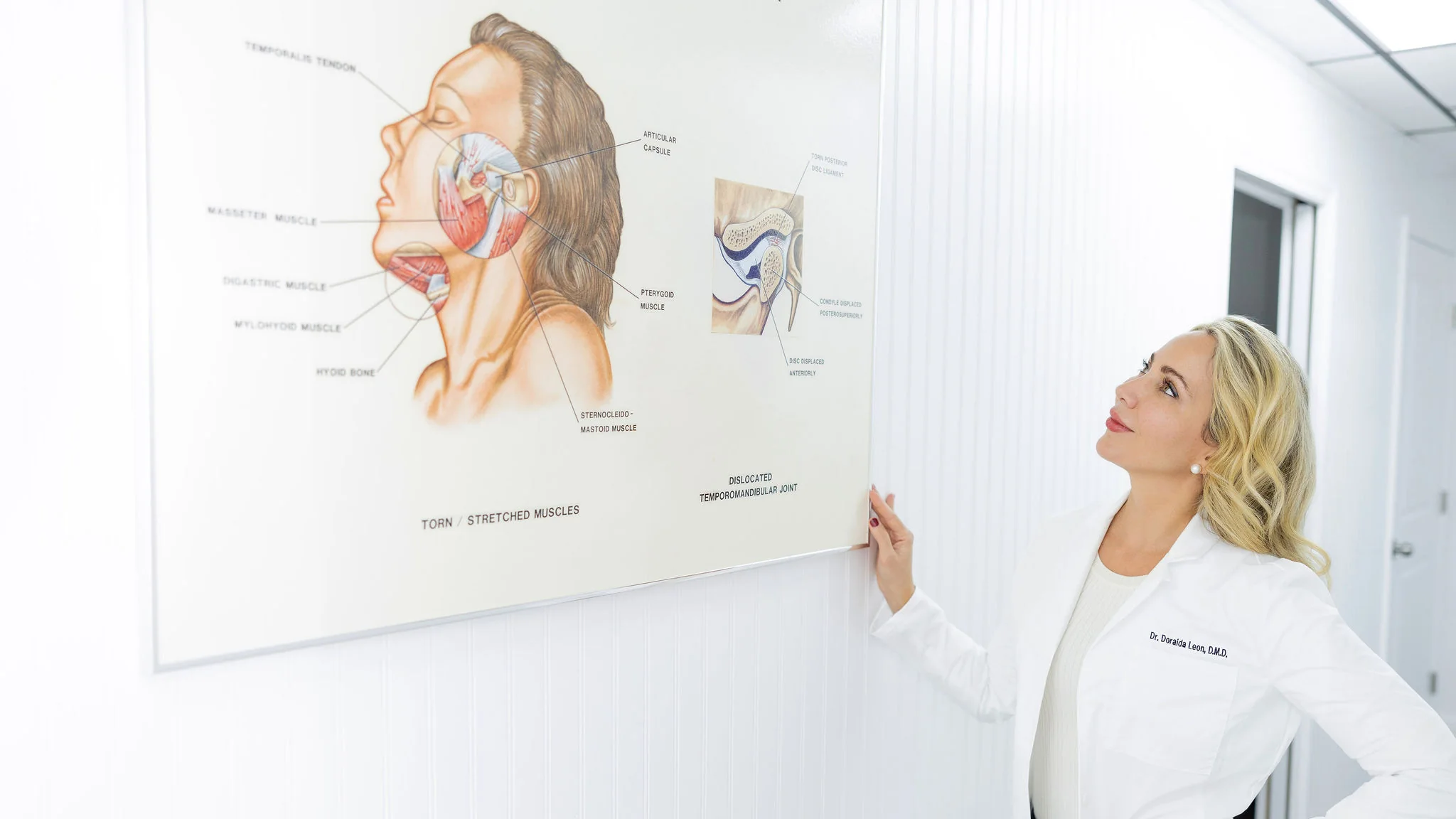
Your first visit, step by step.
Listen.Dr. Leon reviews your health history and symptom questionnaire with you. She asks when your symptoms began, how they affect your daily life, what makes them better or worse, and what you hope to improve.
Examine.Dr. Leon examines your head, neck, face, and jaw, as well as the inside of your mouth. She checks your joints, muscles and surrounding soft tissues, teeth and bite; measures how your jaw moves; evaluates areas of tenderness; and assesses your posture. In-office iCAT 3D imaging is available and may be recommended based on your evaluation. It can provide a closer look at the jaw joints, teeth, and other structures captured in the scan, including the nasal passages and airway.
Explain.Dr. Leon discusses her findings and what may be contributing to your symptoms in plain language, in English or Spanish.
Plan.You'll discuss appropriate treatment options and next steps, with time to ask questions. If another evaluation or referral would be helpful, Dr. Leon will explain why.
Before you come inPlan for about an hour. Your visit may take longer if paperwork is incomplete or imaging or treatment takes place that day. The office emails your new-patient paperwork when you book. Please bring a copy of your ID or driver's license. If you are in significant pain, Dr. Leon will discuss whether conservative treatment can begin at your first visit following your evaluation and consent.
New at Tampa TMJ
It is FDA-cleared for TMJ dysfunction and the pain that comes with it. Gentle radiofrequency warms the tissue and eases muscle spasm, while HIFES stimulation works the jaw muscles so they can move the way they should again.

From the blog
Plain answers to the questions patients ask most.
What happens at your first TMJ visit with Dr. Doraida Leon in Tampa: listen, examine, explain, plan. About an hour, in English or Spanish, with real answers.
New or worsening jaw pain after a car accident, fall or sports injury? How Dr. Doraida Leon evaluates your symptoms in Tampa and plans appropriate care.
From your first evaluation to the treatments that can follow.
See all services: All TMJ services at Tampa TMJReviews live on our Google profile, in patients' own words.